
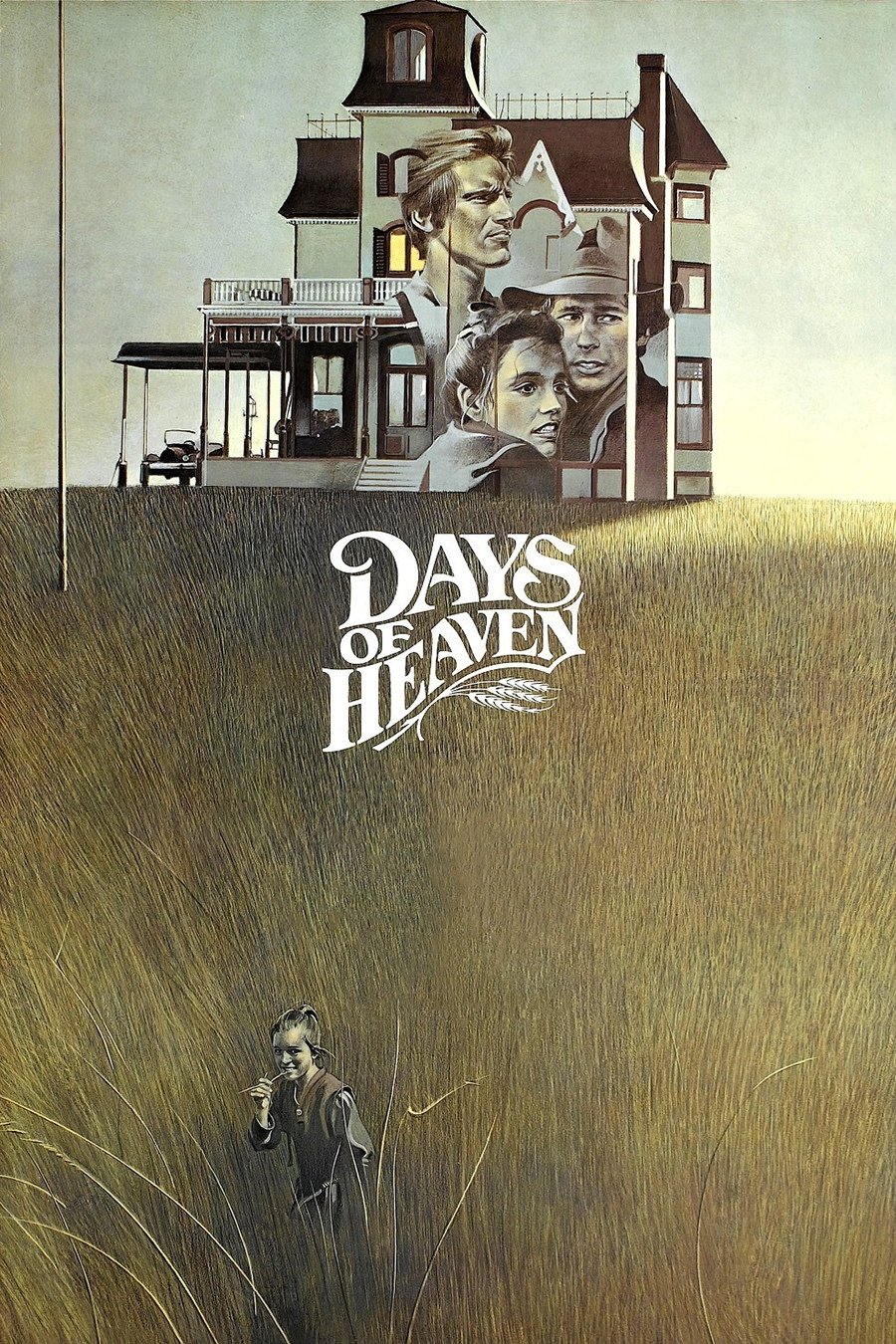
The First-Time Viewing Experience
In all honesty, I remember the first time I sat down for Days of Heaven so clearly that it sometimes feels like a dream I drift in and out of. Before pressing play, all I’d heard were whispers: “the most beautiful film ever made,” “intensely poetic,” “a story told through images rather than words.” I was skeptical—aren’t those just critical clichés? Yet, as the opening credits faded and the first golden sunlight flickered across endless wheat fields, I immediately sensed something singular was about to unfold. There was a patience to the film, a willingness to sit in silence and let the world on screen exist with or without me. I found myself sinking into that world before I could analyze it, swept along on the hush of the wind and the idle clatter of farm tools.
What struck me wasn’t just how pretty everything looked—although that remains an understatement—but how the film seemed to invite me to feel, rather than think my way through its story. The narratives of other movies barrel ahead, but here, I felt gently led by the hand into a place where time was measured by seasons and glances instead of plot points. I remember feeling a quiet awe as Malick, the director, eschewed fast exposition in favor of lingering on the rustle of grass or the uncertain look between lovers. The movie asks for patience—not in a punishing way, but by promising the viewer a kind of truth that emerges only when you let your guard down and surrender to its rhythm.
Most modern viewers—myself included—plunge into films expecting characters to announce their intentions, or for big moments to be underlined with emphatic music cues. Days of Heaven diffuses that expectation from the start. The dialogue is sparse and lived-in, almost overheard instead of performed. At first, this quiet felt alienating to me, as if I was eavesdropping on a memory that didn’t belong to me. But then, about halfway through, I realized how liberating that was. The silences began to feel intimate—an invitation rather than a barrier. Suddenly, I was listening with my eyes, reading stories in the movement of clouds, the changing light, and the faces of the farm workers under the wide Texas sky. I became aware of how rarely I allow myself the luxury of this kind of attention in everyday life.
There’s a humility in the storytelling that’s initially disorienting but eventually feels like a gift. I came to see the film not as a mystery to be solved, but as a meditation to be experienced—like lying in the grass and feeling the sun on your skin, aware of something vast and intangible moving just out of sight. I wasn’t always sure I understood every choice Malick made, but I never felt excluded; instead, I felt trusted. This trust, in many ways, is what moved me beyond appreciation to genuine emotional connection. For a first-time viewer, Days of Heaven is less about “watching a story” and more about being enveloped in one—submitting to a slow, haunting spell that’s hard to shake off long after the final image has faded.
Emotional Moments That Resonate
As I reflect on the moments in Days of Heaven that continue to linger in my memory, I’m surprised by how many of them have no dialogue at all. The film is punctuated by shots where nature seems to rise up and dominate the story—migrating birds, fields set ablaze, the creak of windmills turning against a vast, indifferent sky. One of the first such moments that gripped me was the way Malick films the laborers amid an ocean of wheat at sunset, their silhouettes merging with the land. I remember feeling an ache of loneliness, not so much for the characters themselves, but for the sense of ordinary people dwarfed by forces beyond their control. There’s a kind of beauty in their anonymity, a quiet heartbreak that feels relevant to anyone, at any era, who’s ever felt small in the face of the world’s enormity.
The tenderness of Abby’s fleeting smiles or Bill’s anxious glances meant more to me precisely because they weren’t explained. In an age where everything is spelled out, watching these characters communicate through stolen looks and awkward silences felt profoundly honest. I remember the first time I saw Abby’s hand brushing over the wheat as she walks away from the house, not knowing what to do with the love and pain tangled inside her. That silence said more to me than any confessional could.
For me, the most overwhelming moment is that apocalyptic sequence when the harvested fields are suddenly engulfed in fire. Even watching from the safety of my living room, I felt a primal fear watching the flames consume everything the characters had worked for. The cinematography—as flames lick the horizon and locusts swarm in the sky—felt almost biblical. There’s something about nature’s fury shown here that links the small sorrows of the characters to the larger story of human hardship; Malick lets us feel the immensity of loss, and the beauty that can persist even as everything collapses. It’s the cinematic equivalent of witnessing a storm roll in: frightening, humbling, and impossibly beautiful.
One scene that hit me unexpectedly hard is Linda Manz’s narration. Her voiceover, raw and unpolished, flows like a child lost in reverie. Sometimes she’s recounting events as she remembers them; sometimes she seems to be musing for her own comfort. For me, her voice isn’t simply storytelling—it’s an emotional thread tying the entire tapestry together. The way she describes loss and fleeting happiness with a matter-of-fact innocence captures a child’s bewilderment in the face of adult tragedy. I felt that combination of wisdom and uncertainty in my bones, as if the film knew things about growing up that I hadn’t admitted to myself yet.
Looking back, I realize that Days of Heaven thrives on its contradictions. It’s full of longing and melancholy, but also suffused with wonder. Few films have left me both exhausted and uplifted the way this one has—like I’d witnessed not only a beautifully told story but been reminded of how intimately joy and sorrow intertwine. It’s these moments, more than anything, that make me want to return to it: a film that holds ache and hope in the same trembling hand.
How to Appreciate This Film Without Prior Knowledge
One of my biggest worries before pressing play was that I’d somehow be left behind, that a film so revered would require expertise in cinema history or an intimate knowledge of the Dust Bowl era. I can say, without reservation, that my fears were misplaced. The beauty of Days of Heaven is that it meets you exactly where you are—there’s no secret code or graduate seminar required to appreciate what’s unfolding on screen.
Sometimes, I think the best way to approach Malick’s work is by letting go of the idea that you need to “get it right.” The first scenes unsettled me because there wasn’t a roadmap: What matters? Whose story is this? But then I realized, like watching clouds change shape, part of the joy is letting yourself wonder. When I gave myself permission to observe, absorb, and feel, layers of meaning revealed themselves naturally. You don’t need to catch every narrative detail. For me, recognizing that the film’s power lies as much in its mood and images as in its story made the experience richer and more rewarding.
There are references and visual motifs that film historians might get excited about—the influence of painters like Andrew Wyeth or Edward Hopper, the use of natural light reminiscent of turn-of-the-century photography—but I promise: even without knowing those things, I was moved just as deeply. What’s striking is how immediate the emotional impact is. The play of sunlight across a dinner table, the vulnerability exposed in a single close-up, the mournful drift of a harmonica—none of that requires translation or background. The film feels closer to poetry than prose, inviting each viewer to bring their own meaning to the experience.
When friends ask me how to prepare for their first viewing, I always tell them to arrive with patience and an open heart. You don’t need encyclopedic knowledge; in fact, sometimes knowing less is a gift, allowing you to discover the story’s vivid textures for yourself. The huge, wordless beauty that unfolds is something anyone can feel, regardless of whether you’ve ever studied a frame of film or read a line of criticism. In my experience, the less I try to analyze in real time, the more I walk away with—a powerful reminder that some of cinema’s greatest rewards come from simple, attentive watching.
Who This Film Is Best Suited For
- Lovers of visual storytelling who delight in expressive cinematography and mood over exposition.
- Viewers who find themselves moved by atmosphere, longing, and the inner worlds of characters rather than just dramatic twists.
- Anyone seeking a meditative, soul-soothing film that leaves room for interpretation and personal reflection.
A Beginner’s Final Recommendation
If you’re standing at the edge, wondering whether Days of Heaven will speak to you, I hope my own experience reassures you: this is a film that rewards openness and imagination. I approached it wondering whether its visual splendor could possibly serve more than empty beauty, and left realizing I had witnessed something profound—an encounter not just with art, but with the act of seeing and feeling itself. It’s daunting to describe Malick’s magic without resorting to big, swooning generalities; the truth is, his work makes me want to speak in whispers, to recall the small delights of sun on skin and the ache of leaving home.
Don’t worry about missing hidden meanings or failing to “keep up.” The film doesn’t lecture; it invites. The first time, I found myself just as awestruck by a sudden breeze through the fields as I was by a whispered confession. I always encourage others to let the film’s emotions and images wash over them, noticing what tugs at their attention and holding onto those moments. If you go in expecting a traditional drama, you may at first feel unmoored, but soon I suspect you’ll realize, as I did, that there’s an uncanny honesty running through every frame.
I now see Days of Heaven less as a narrative to be followed beat by beat, and more as an experience to surrender to wholeheartedly. The film’s greatest gift is the way it deepens your sense of empathy—toward strangers, places, and even your own memories. For a beginner, there’s nothing required but willingness: willingness to let the world slow down, to listen to what’s unspoken, to appreciate the shades of light even as dusk falls. My one piece of genuine advice? Allow yourself to watch with no expectation—only curiosity—and notice which images or emotions linger when the credits roll. Those are the gifts Malick offers to each of us personally, every time.
To understand whether timeless appeal still resonates today, modern reassessments are worth exploring.
🎬 Check out today's best-selling movies on Amazon!
View Deals on Amazon