
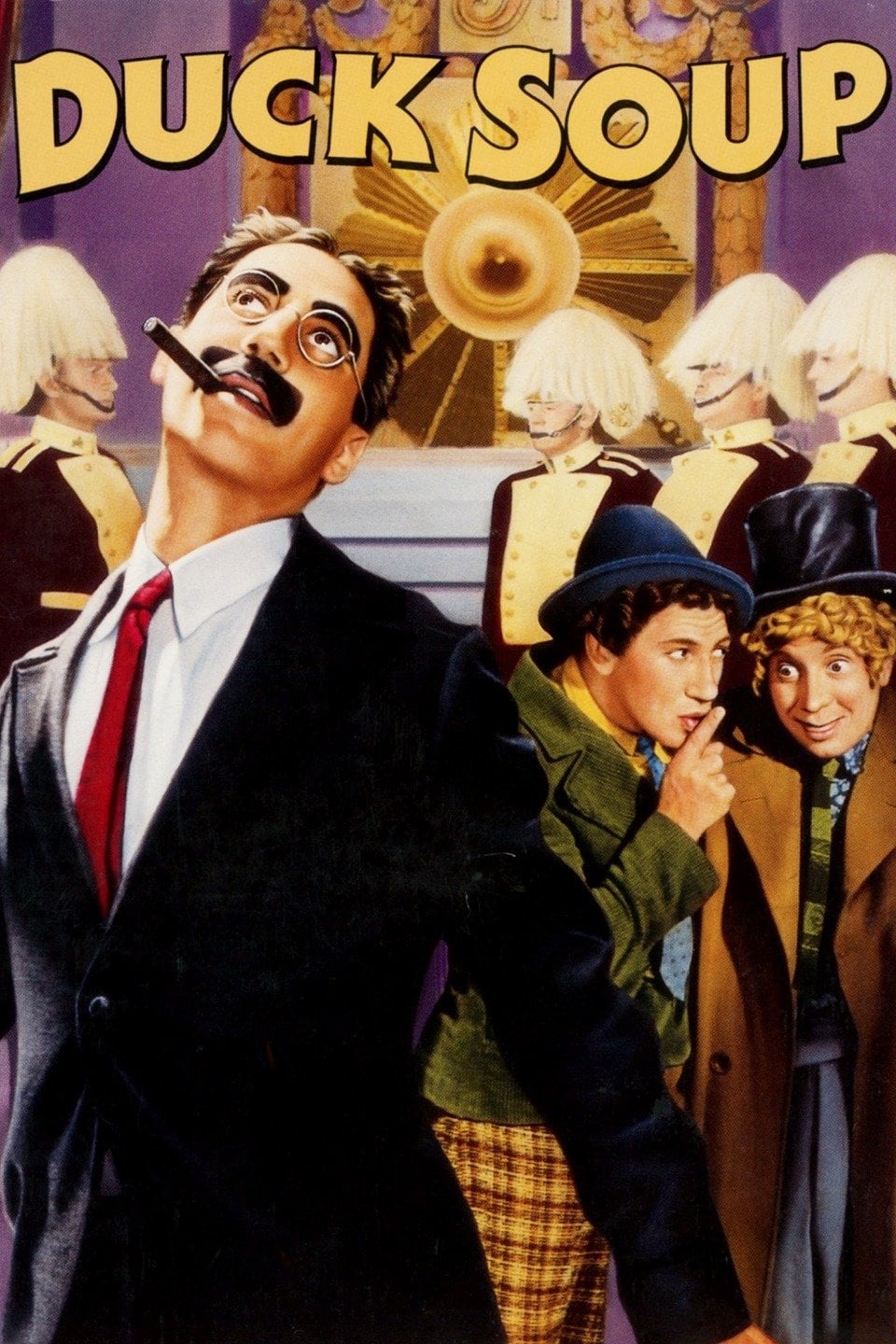
The First-Time Viewing Experience
My first encounter with “Duck Soup,” a 1933 comedy whirlwind crafted by the Marx Brothers, wasn’t driven by reverence for cinematic history or scholarly curiosity. Honestly, it was curiosity about a film so often cited as “essential,” yet entirely unfamiliar to me aside from a few scattered stills of Groucho’s unmistakable mustache and Harpo’s wild-eyed grin. Hitting play, I braced myself for a black-and-white relic—a museum piece. What actually washed over me was something far less academic and infinitely more electrifying: a sort of gleeful, controlled chaos that completely upended my expectations of what old movies can feel like.
From the very first scenes, I found myself struck not so much by the historical context, but by the sense of pure, unfiltered mischief that radiates from the screen. For decades, I’d been trained by popular culture to expect classic movies to be tame, polite—or at the very least, anchored by a kind of formality. “Duck Soup” felt, to me, like a happy act of rebellion against all that. Its opening moments set the tone with Groucho’s Rufus T. Firefly ushered into the presidency of Freedonia on the thinnest of pretexts, heralded by anthems and adulation that are all played for laughs. Immediately, I recognized in the Marx Brothers’ rhythm something startlingly modern: no moment lingers longer than the next punchline requires, and logic is perpetually one step behind the joke. The result for a first-time viewer is almost disorienting—you learn quickly to just surf the wave of their anarchic energy rather than search for the sort of coherence you might expect elsewhere.
Sitting there, I felt a peculiar mix of surprise, delight, and—admittedly—a little nervousness. Comedy from nearly a century ago can sometimes feel foreign, but “Duck Soup” is more like a rapidly spinning funhouse mirror, endlessly reflecting and refracting my own sense of humor. The Marx Brothers, with their relentless one-liners and gleeful disregard for narrative order, completely collapse the distance between audience and screen. It’s the kind of experience where I stopped watching and started just surrendering to it, letting each outrageous sequence and incomprehensible bit of wordplay sweep away my hesitancy. Laughter—unexpected and almost involuntary—is the sensation I remember most. It reminded me that the boundaries of time and taste aren’t as rigid as they seem; what made people roar with laughter then still has the power to catch me totally off guard now.
There’s something strangely exhilarating about not knowing where a scene will go next. For someone who’s conditioned by decades of cinema to expect emotional arcs or carefully modulated pacing, the sheer unpredictability is jarring—in the best way. The anticipation before each gag, each visual stunt, left me a little breathless, trying to guess how far the Brothers would let their disregard for reality stretch. This, to me, is what sets “Duck Soup” apart for new viewers: not just the laughter, but the bracing, almost physical jolt of watching something so joyously unconcerned with the boundaries of sense or story. It was unlike any other old film I’d sat through, and that sense of discovery has lingered with me long after the credits rolled.
Emotional Moments That Resonate
I always thought a slapstick farce from the 1930s would feel distant or even emotionally flat, but my experience proved the contrary. “Duck Soup”’s laughter, as I found, is frequently laced with a poignancy that sneaks up on you. There is a kind of liberation in the very fact that the Brothers refuse to play by the rules—society’s, the government’s, or even the medium’s. I experienced this most powerfully in the iconic mirror scene; every time Groucho and Harpo—one disguised as the other—perform their silent ballet on either side of a frame where a door ought to be, there’s magic beyond the obvious humor. Watching it for the first time, I was struck by a sense of unity between performer and viewer: they’re both in on the joke, both aware of the absurdity, and that shared recognition feels remarkably contemporary. There’s laughter, of course, but also an odd tenderness, a shared relief in the simple fact that, for a moment, everyone is playing together in the same strange sandbox.
Another resonance, for me, came from the film’s relentless puncturing of authority. As I watched Groucho mock bureaucracy as President Firefly, gleefully skewering ambassadors and ministers without mercy, I felt a resonance that felt terribly current—the notion that no leader is truly in control, and that the powerful are often the silliest of all. It’s not just surface-level satire; the humor emerges from a palpable frustration with systems that fail, but the act of laughing at them becomes cathartic. Every time Firefly refuses to take anything seriously, I found myself processing all the times in my own life when laughter was the only rational response to a farcical world. There’s an emotional core here, buried beneath quick-fire jokes, that reassures me the world has always been a little mad—and that’s okay.
Finally, I’d be remiss not to mention how “Duck Soup” manages to draw on the nervous energy of its own era—the tail end of the Great Depression, war clouds gathering in Europe—and twist it into anarchic glee. There’s a peculiar comfort in that, the sense that even in uncertain times, there’s room for this kind of exuberance. The climactic battle scenes, with their barrage of costumes and shifting backdrops, collapse the chaos of real conflict into pure, liberating nonsense. It’s brave in its refusal to teach or moralize; instead, I felt only the joy of watching artists create a sanctuary from seriousness, one laugh at a time. This emotional permission—to see absurdity as a form of resilience—is what I most treasure about my first watch, and what resonates with me long after the last pie was thrown.
How to Appreciate This Film Without Prior Knowledge
One of my biggest worries before sitting down with “Duck Soup” was the nagging notion that comedy from so long ago would require some kind of historical map—a primer on the politics of the 1930s, biographies of the Marx Brothers, or a PhD in film studies. What I actually discovered was the exact opposite. I was surprised by how little context is truly required to be swept up in the film’s relentless spirit. Everything you need is already right there in the frame: the faces, the voices, the rhythm of the jokes, the simple joy of watching grown men behave like mischievous children. I realized pretty quickly that “getting” the film doesn’t mean parsing out references or having encyclopedic knowledge; it’s about letting yourself laugh without self-consciousness.
My advice, especially for first-time viewers, is to relinquish the urge to analyze every moment or map the antics onto an allegorical meaning. Instead, I found far more satisfaction in just giving in. The best way I found to approach “Duck Soup” was with an open mind and a willingness to let the movie set its own tempo. The absurdity is universal, the visual gags are often self-explanatory, and while some musical interludes might feel like a product of their time, the genuine inventiveness shines through. I was amazed—freed, even—by the realization that the film’s humor is based on subverting every expectation, including those about “classic” movies themselves.
If you’re new to old films, don’t be intimidated by the black-and-white picture or the vaudeville-inspired structure. These aren’t barriers, but rather invitations to a different kind of storytelling—one powered less by plot than by the delight of the game being played. For me, the laughter was contagious, often contagious because I never felt left behind by some insider knowledge. In a world where so much entertainment demands we keep up or miss out, “Duck Soup” extends a hand and simply says, “Join in.” That is a gift that requires nothing more than a sense of humor and a willingness to be delighted.
Who This Film Is Best Suited For
- Anyone craving a break from seriousness or cynicism, seeking pure, unfiltered joy
- Viewers who feel intimidated by “classic” cinema and want the most welcoming, playful introduction
- Comedy fans eager to trace the origins of surreal, offbeat, or anarchic humor found in today’s movies
A Beginner’s Final Recommendation
If facing “Duck Soup” for the first time feels daunting, I completely understand; it did for me, too. I went in expecting something creaky and perhaps a little worthy, but I ended up laughing harder and more freely than I had in ages. My experience taught me that films don’t have to be serious, or even logical, to be deeply rewarding. “Duck Soup” is a celebration of the absurd—the idea that comedy doesn’t age if it finds the right note to strike in your heart. Whether you’re a lifelong comedy fan or someone gently easing into older movies, I can promise from my own first watch that the Marx Brothers are true ambassadors of joy. They want nothing more than to sweep you up into their wild parade, and all you need to bring is your own curiosity.
Give yourself over to it. Let go of expectations about structure, story, or cultural references you might think are missing. If you do, you might discover—as I did—that the most enduring classics are those that treat their audience like trusted partners in mischief. “Duck Soup” left me lighter, more hopeful, and oddly connected to generations of people who’ve found catharsis in laughter when they needed it most. It reminded me that some pleasures really are timeless, no matter how many years have passed. If you’re on the fence about your first journey with the Marx Brothers, take the plunge. It’s an incomparable ride, and one I’m endlessly grateful to have experienced.
To understand whether timeless appeal still resonates today, modern reassessments are worth exploring.
🎬 Check out today's best-selling movies on Amazon!
View Deals on Amazon